WorthPoint
- 2.7
- Rating
- 100.00K
- Installs
- Free
- Price

 Analysis by App-foxy
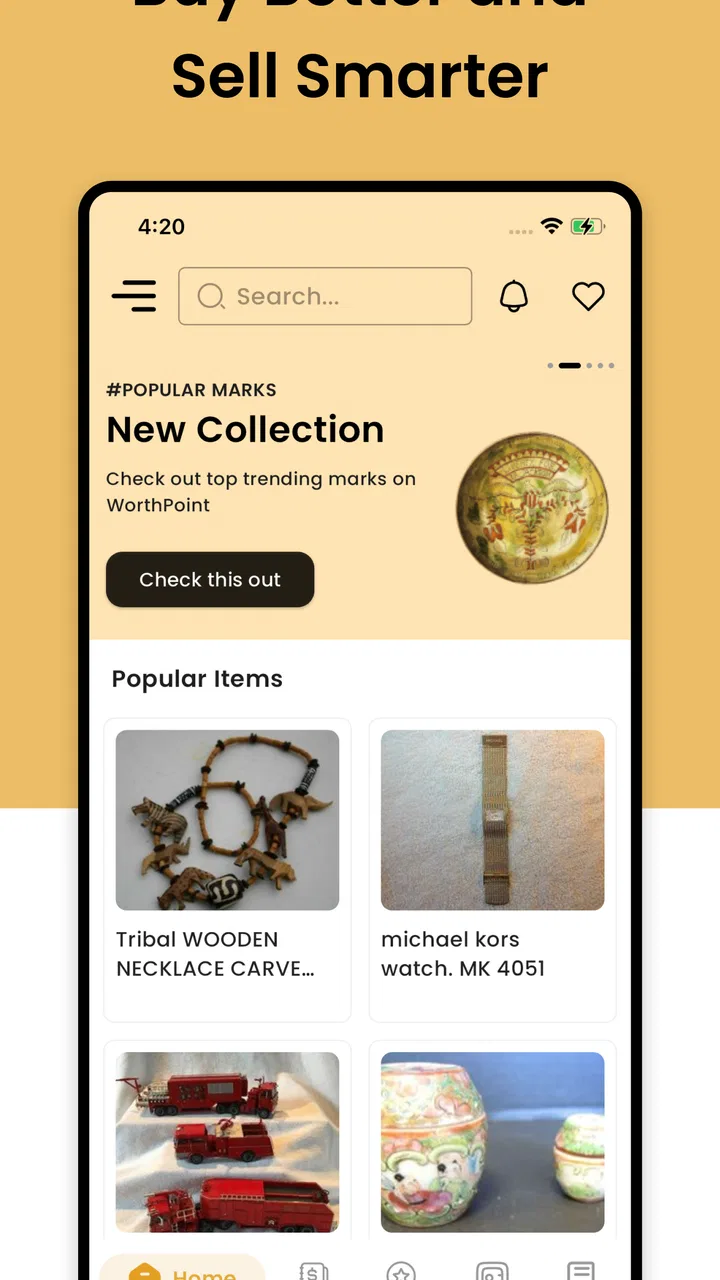
When I look at an old object and wonder whether it is genuinely valuable or simply attractive, the difficult part is usually not finding a similar picture. The difficult part is finding enough context to make a sensible comparison. That is where WorthPoint tries to help. This free shopping app from WorthPoint is built around antiques and collectibles research, so its real purpose is not casual browsing or impulse buying. It is a research tool for people who want to understand an item before selling, buying, donating, insuring, or passing it on.
I found the app most useful when I treated it as a starting point for a careful investigation rather than as an instant valuation machine. An image or a familiar-looking mark can point me in the right direction, but the final judgment still depends on condition, authenticity, completeness, provenance, and the details that make one collectible different from another. That distinction matters because a broad visual match can be misleading. The app is strongest when it turns uncertainty into a more focused research question.
WorthPoint is listed in the Shopping category, carries a Teen content rating, and has reached over one hundred thousand installs. Its average rating is 2.7 from around six hundred ratings, with roughly two hundred eighty written reviews, so I would not approach it as a universally polished experience. Those numbers suggest a mixed user experience, and that matches the way I would recommend it: useful for a specific research job, but not necessarily the best everyday shopping companion.
You May Also Like

 Blood Strike: 2.5 Anniversary
Blood Strike’s Loadouts Turn Every Drop Into a Tactical Gamble
A close look at Blood Strike’s custom loadouts: how fast access to signature weapons reshapes its battle royale rhythm, rewards preparation, and narrows the gap between fights.

 Pandora - Music & Podcasts
Pandora’s Music Is Easy to Start, but Harder to Recover
Pandora’s strength is its low-effort path from a seed to a station. Its weak spot is how much confidence it asks you to place in connection, setup, and quiet recovery.

 8 Ball Pool
 Is Built on Rivalries, Rematches, and Routine
A close look at the rivalries, rematches, shared routines, and unanswered safety questions that turn a quick pool match into a persistent mobile community.

 Samsung Music
’s Quiet Strength Is Playing What You Already Own
Its reach comes less from spectacle than from dependable access to a personal library. That simplicity is both the app’s strongest retention engine and its ceiling.

 AccuWeather: Weather Radar
AccuWeather Review: A Quick, Clear Forecast for Everyday Decisions
For everyday plans, the best forecast is the one you can understand quickly. AccuWeather makes rain timing, radar, and local conditions easy to act on, with a few trade-offs.

 Hill Climb Racing
Why Hill Climb Racing Still Turns Crashes Into One More Run
A tiny car, a bumpy hill and one more upgrade: Hill Climb Racing keeps resurfacing because its simple chaos makes every near-miss feel personal.
More From Our News Desk
View All News


Researching an object instead of guessing its price
I’d begin by checking the connection before treating a promising match as a conclusion: research is most useful when I can follow up on clues, compare examples, and keep the object’s details in view. That makes this section less about chasing a number and more about how I use WorthPoint to build a case for what an item might be.
The central capability is historical context
The most important capability here is the ability to research antiques and collectibles in a more structured way than a normal web search. Instead of relying only on current listings, I can use the app to investigate an object’s identity and compare it with related examples. That changes the question from “What is this worth?” to “What exactly is this, and what evidence supports its value?” In practice, that is a much safer question.
For example, a ceramic piece may look like a common decorative item until I notice a maker’s mark underneath. A piece of jewelry may resemble several inexpensive designs but turn out to belong to a particular period or collection. A toy may appear complete at first glance while missing packaging, accessories, or a small component that affects desirability. WorthPoint becomes more relevant as these details accumulate because research is rarely about the object’s general appearance alone.
I also like the fact that this approach encourages comparison rather than a single dramatic number. Collectibles are affected by condition and presentation in ways that ordinary household goods are not. Two objects with the same manufacturer and model can attract very different interest if one has damage, restoration, fading, replacement parts, or original packaging. A research app cannot remove those variables, but it can help me notice them before I make a decision.
What I would prepare before opening it
The quality of the research depends heavily on the information I bring to the search. Before using the app, I would photograph the front, back, underside, labels, signatures, stamps, serial marks, fasteners, and any damage. I would also write down dimensions and note whether the object has its original box, paperwork, matching pieces, or removable parts. This preparation is more valuable than repeatedly searching a vague description such as “old vase” or “vintage bracelet.”
A useful habit is to separate observation from interpretation. I might record “blue floral decoration, raised gold edge, mark under base” rather than immediately deciding that the item belongs to a famous brand. That keeps the first search open enough to reveal alternatives. Once I have a likely maker or period, I can narrow the investigation and compare more relevant examples.
This workflow is one of the less obvious strengths of using a specialist research service. A general image-search tool often rewards the closest visual match, even when the object is a reproduction or a different version. WorthPoint is better suited to the slower process of identifying clues, checking related objects, and building confidence step by step.
How it fits into a real household task
Imagine I am clearing a relative’s home and find several boxes of mixed items. I would not photograph every object and expect an immediate answer. I would first sort the contents into groups: marked ceramics, signed artwork, watches, costume jewelry, toys, books, and unmarked decorative pieces. Then I would begin with objects that have visible identifiers or a plausible collecting history.
For each promising item, I would create a small research note with the object’s measurements, condition, markings, and missing parts. I would use the app to investigate possible matches, then keep the strongest candidates separate from uncertain ones. This prevents a common mistake: treating the most expensive similar-looking result as proof that my item has the same value.
The app is particularly helpful at this stage because it gives the process a research focus. Even if I do not reach a confident conclusion, I may discover the correct terminology for a style, maker, material, or category. That vocabulary can make later conversations with a dealer, auction house, specialist group, or insurance professional much more productive.
What the experience feels like in practice
I would describe the experience as more investigative than entertaining. Someone looking for endless product discovery may find it too narrow, while a collector or seller can appreciate the purpose. The app’s store summary is simply antiques and collectibles research, and that concise description is fair: it signals a focused tool rather than a broad marketplace with every type of retail product.
The current version is 6.3.1 and it supports devices running Android 8.1 or later. For a user with an older phone, that minimum requirement is worth checking before planning a research session. The app itself is free to install, but in-app purchases range from around twenty dollars to around four hundred dollars per item. That is a major practical consideration. I would not begin by assuming that the free download gives unlimited access to every research resource.
Because the possible purchase range is substantial, I would first test whether the app fits my particular research habit. If I only need to identify one inherited object, paying for a deep research resource may not make sense. If I regularly buy and sell collectibles, the cost could be easier to justify, but only when the information saves me from a costly buying mistake or helps me describe an item accurately.
The best scenario is pre-sale research
The situation in which I see the clearest benefit is preparing a collectible for sale. Before writing a listing, I would want more than a confident-sounding title. I would want to know which identifying details buyers may search for, which condition issues need to be disclosed, and whether the object belongs to a narrower category than I first assumed.
That research can improve the quality of a listing even when it does not produce a precise selling figure. A description that accurately mentions a maker’s mark, design period, model variation, or missing component is more useful than one built around vague words such as “rare” or “antique.” It also reduces the chance of promising something the object cannot support.
There is a practical trade-off here. Research takes time, and time has value. For a low-value item found at a yard sale, a quick visual search may be perfectly reasonable. For a signed object, a group of inherited collectibles, or something I paid a meaningful amount for, the slower specialist approach becomes more worthwhile. I would reserve WorthPoint for the second group rather than use it for every household object.
Why a normal web search is not always enough
General search engines are excellent for discovering terminology and finding current listings, but they can mix retail asking prices, completed sales, reproductions, unrelated versions, and visually similar objects. That makes them useful for clues but risky as a final authority. A marketplace search can tell me what sellers hope to receive; it does not automatically tell me what an item actually achieved or whether the comparison is truly equivalent.
WorthPoint’s specialist focus gives it a different role. I would use a web search to learn possible names and a marketplace to understand the present competition. I would use this app when I need a more deliberate antiques-and-collectibles research trail. None of these tools replaces expert inspection, but combining them is more reliable than trusting one attractive result.
There is also a difference between identification and valuation. Identification asks what an object is. Valuation asks what it may be worth in a particular condition, location, market, and moment. The first can often be improved through photographs and markings. The second remains more uncertain, especially for unusual items. I would never make a major purchase or sale solely because an app surfaced a promising comparison.
Three habits that make the research more useful
My first tip is to search in layers. Begin with the broad object type, then add the maker or mark, then add the unusual design detail. Starting with a very specific guess can hide the correct result if the guess is wrong. Layered searches let me compare possibilities without locking myself into one interpretation too early.
My second tip is to treat condition as part of the identity, not as an afterthought. I would record chips, cracks, repairs, discoloration, replaced hardware, missing inserts, and signs of wear before comparing examples. A beautiful photograph can make a damaged object appear more valuable than it is. Writing down flaws first helps keep the research honest.
My third tip is to save the reasoning, not just the apparent answer. I would note why a comparison seemed relevant: the same mark, matching dimensions, an identical pattern, a particular mechanism, or a distinctive accessory. This is especially useful when researching several items at once. It also makes it easier to explain my conclusion to a buyer or family member without presenting the app as an unquestionable authority.
A fourth useful habit is to separate a research result from a selling strategy. Even if an object has a strong collecting history, the best place to sell it may depend on shipping risk, local demand, specialist interest, and the effort required to describe and pack it. The app can inform the object’s background, but it does not remove those practical decisions.
Where the friction becomes noticeable
The mixed rating is important context for anyone expecting a flawless mobile experience. I would keep my expectations measured, particularly around navigation, access to research material, and the difference between browsing a free app and using paid resources. An app can be valuable in concept while still feeling inconvenient when I am trying to move quickly through several objects.
The purchase range also creates uncertainty about value for money. A person researching one inherited plate may feel that a premium resource is disproportionate to the task. A dealer handling many categories may see the calculation differently. Before spending anything, I would decide what question I need answered and what a reliable answer is worth to me. That simple step prevents the app from turning a small research task into an unnecessary expense.
Another limitation is the danger of false confidence. Finding a similar collectible can feel like finding proof, especially when the comparison looks visually convincing. I would still verify measurements, marks, completeness, and condition. If the item is potentially valuable, I would seek a qualified human opinion before treating the research as a final valuation.
Who should use it and who should skip it
I think the best audience is made up of collectors, antique sellers, estate clearers, vintage shoppers, and families sorting inherited possessions. These users are likely to encounter objects where terminology and history matter more than a quick current-price search. The app is also useful for someone who enjoys research and does not mind building a conclusion from several clues.
I would be more cautious recommending it to a casual shopper who only wants a fast answer while standing in a thrift store. In that situation, a general image-search app or a quick marketplace comparison may be faster and adequate for a low-risk purchase. I would also skip it as a primary tool for modern retail shopping because its focus is specifically antiques and collectibles.
Professional users should think about workflow volume before paying for anything. If I regularly evaluate many objects, the service may save time by giving my research a consistent direction. If I only encounter collectibles once or twice a year, I may get better value from combining free searches with a specialist appraisal for the few items that truly matter.
My recommendation after using it as a research tool
WorthPoint makes the most sense when I need context, not instant certainty. Its focused role in antiques and collectibles research can help me identify better search terms, compare relevant objects, and prepare a more accurate description before I buy or sell. The strongest result is often not a final price but a clearer understanding of what I have and what still needs checking.
I would install it for a collection, an estate cleanout, or a serious vintage purchase, while keeping photographs, measurements, condition notes, and independent checks alongside it. I would not assume that the free installation covers every useful resource, and I would think carefully before using the paid options because individual purchases can become expensive.
Overall, I see it as a specialist companion rather than a magic appraisal button. If you enjoy careful research and regularly handle antiques or collectibles, it can give your investigation more direction than ordinary browsing. If you need a quick answer for an inexpensive object, or if you want a broad shopping app, another option will probably be more convenient. For the right user, though, the real advantage is learning how to ask a better question about an object before putting a price on it.
FAQs for WorthPoint
01What is WorthPoint, and what can I use it for?
WorthPoint is an online research platform for antiques, collectibles, art, jewelry, furniture, and other secondhand items. It provides access to historical sales data, auction records, images, and related information that can help you estimate an item’s market history. It is mainly designed for collectors, dealers, appraisers, and anyone researching an object before buying or selling it.
02Does WorthPoint provide accurate valuations for antiques and collectibles?
WorthPoint can be a useful valuation reference, but it should not be treated as an official appraisal or a guaranteed selling price. Its estimates are based on historical listings and recorded transactions, while an item’s condition, authenticity, rarity, provenance, location, and current demand can significantly affect its value. Comparing several records and consulting a qualified expert is recommended for important items.
03Is WorthPoint free to use, or does it require a subscription?
WorthPoint offers limited access to some information, but many of its most useful features, including extensive historical price data and detailed research tools, generally require a paid membership. Subscription options, trial availability, pricing, and included benefits may change over time. Before downloading or signing up, review the current plan details, renewal terms, and cancellation policy shown by WorthPoint.
04Can I use WorthPoint to identify an item from a photograph?
WorthPoint can help with identification research when you search using descriptive terms, maker names, model numbers, markings, categories, or visual clues found in an item’s photographs. However, it may not automatically identify every object from a single image, and similar-looking pieces can have very different values. Clear photos, measurements, labels, signatures, and condition details will improve your research results.
05Is WorthPoint available as a mobile app for Android and iOS?
WorthPoint’s availability and feature set may differ between its website and any mobile experience offered for Android or iOS. Some users may access the service through a mobile browser rather than a dedicated application, so it is important to check the official Google Play Store, Apple App Store, or WorthPoint website before downloading. Also verify developer information, supported devices, account requirements, and subscription features.
Pros
- Detailed pricing history helps estimate an item's potential value.
- Large archive covers many collectibles and vintage categories.
- Image-based research makes identifying unfamiliar items easier.
- Saved searches can support ongoing collection and resale research.
- Useful for comparing similar listings before buying or selling.
Cons
- Most valuable research tools require a paid subscription.
- Some niche items have limited sales data or outdated records.
- Results may overwhelm beginners unfamiliar with collectible terminology.
- Estimated values can vary widely from current local market prices.
- The app is less useful for everyday products without collectible history.

WorthPoint
Gallery